Discover your style

Bachata

Bachata began as working-class Dominican music that polite society tried not to hear. Today its guitars, closeness, and playful partner conversation fill dance floors around the world.

Find studiosClass rules and availability come from each provider.
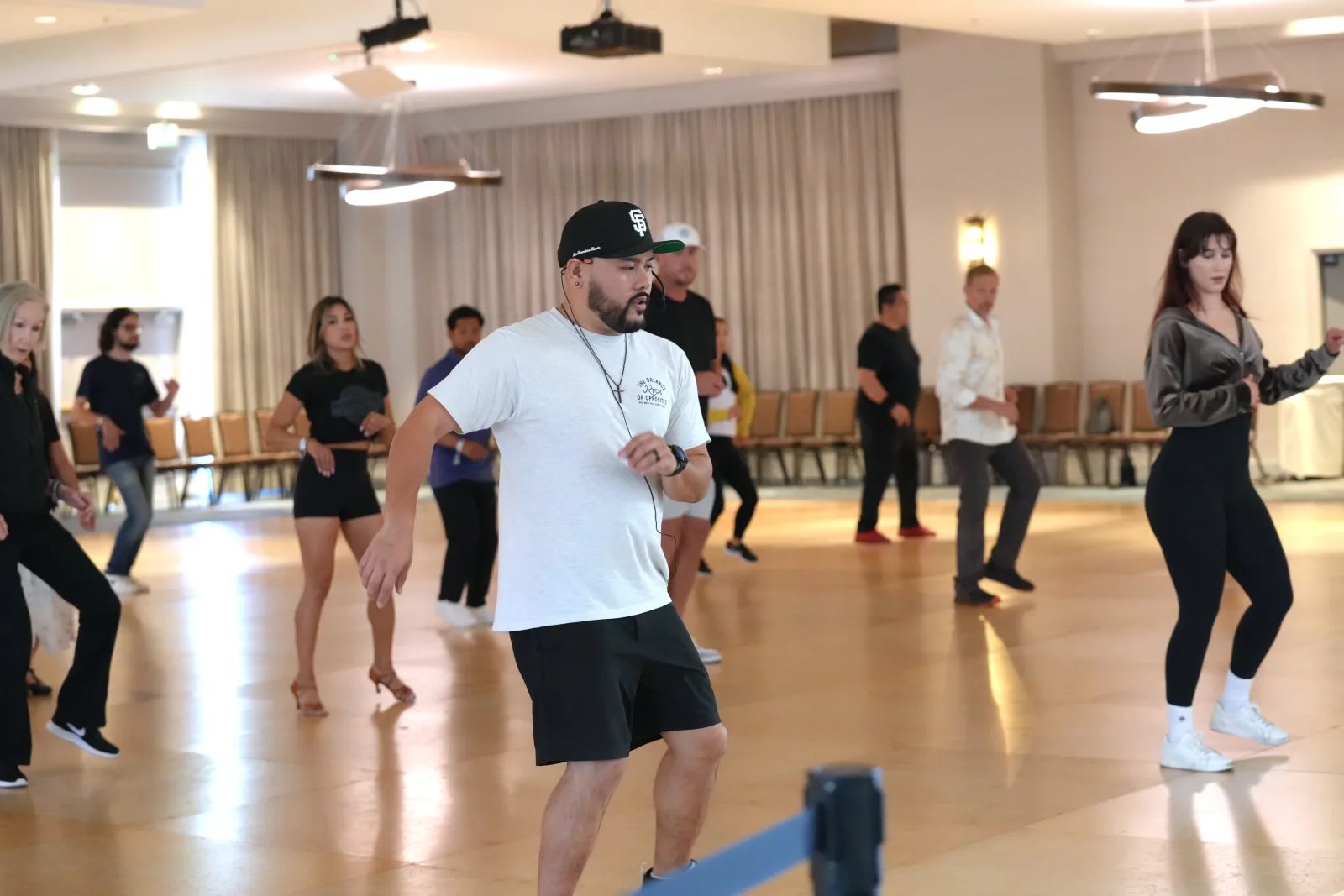
A group practises Bachata footwork in a bright dance hall.
A Bachata Basic Breakdown class with Kris and Lara, California Dance Festival, 2025. Rosiestep / Rosie Stephenson-Goodknight · Wikimedia Commons ↗ · CC BY-SA 4.0 ↗ · resized, WebP
Researched guideBy Noriu ŠoktiPublished 2026-09-17Updated 2026-09-18
In this article
  1. What might a first class feel like?
  2. Origins and culture
  3. See what to notice
  4. Hear the music change
  5. The teacher changes the dance
  6. One name, several ways to dance

01

What might a first class feel like?

The first time the guitar kicks in, your feet may want to move faster than your brain. A teacher gives you a simple side step, and minutes later you are turning it into a small conversation for two.

Many social-dance classes welcome people who come alone, though each studio sets its own rules. If partners rotate, you will feel how the same step changes with each person in the room.

You do not have to perform sensuality on command. A good beginner class starts with rhythm, safe weight transfer, and clear connection. Closeness, turns, and styling come only when both people are ready.

02

Origins and culture

Bachata emerged in the Dominican Republic in the 1960s. Guitar-led songs carried stories of heartbreak, drinking, jealousy, and ordinary life while people danced in courtyards, bars, and family gatherings.

For years it was disreputable music. Radio preferred merengue and salsa, while middle- and upper-class listeners called bachata vulgar. Musicians built their own recording and distribution world because the mainstream shut them out.

Migration, cassettes, Dominican communities in New York, and artists such as Juan Luis Guerra changed that status. The success of his Bachata Rosa era carried the music into rooms where earlier bachata had not been welcome.

Later, Aventura, Romeo Santos, Monchy & Alexandra, and Prince Royce brought bachata to new diaspora and global audiences. As the music travelled, its sound changed—and so did the ways people danced to it.

Culture, not only steps

Before it named a genre, “bachata” referred to a lively gathering. That explains the dance: it was not born for an exam or stage, but for nights when music, flirtation, humour, and disappointment belonged to everyone.

The guitar often tells the melodic story, the güira draws a steady metallic pulse, bongos answer, and the bass holds the floor. Once you hear those layers, the steps stop feeling like a count sequence.

A modern class may use Dominican guitar bachata, New York urban bachata, a pop remix, or a slower sensual track. Ask which world the teacher is opening—the word “bachata” alone does not tell you.

03

See what to notice

Side-to-side foundation

Three steps and an accent fill one side of the phrase, then the direction changes. Watch how weight travels through the body, not only the pattern drawn by the feet.

Hip movement

The hip responds naturally to the step and weight change. If you have to force it, you may have missed the more important part: support and timing.

Partner connection

Leading is not pushing, and following is not guessing. Both people exchange timing, direction, and tone. Distance may change, but consent cannot be assumed.

UNESCO: music and dance of Dominican bachata

See bachata in its social and cultural setting.

© Centro León, 2018 · UNESCOOpen the original source ↗

04

Hear the music change

  1. Cariñito De Mi VidaLuis Segura

    For historical listening: notice the compact arrangement, voice, and role of the guitar.

    Spotify ↗
  2. Burbujas de AmorJuan Luis Guerra 4.40

    A polished studio example: compare the instrumental layers and four-beat pulse.

    Spotify ↗
  3. ObsesiónAventura feat. Judy Santos

    A later, highly produced example. Listen for what remains recognizable as the arrangement changes.

    Spotify ↗
  4. Dos LocosMonchy & Alexandra

    Two voices turn the song into an argument. Hear how vocal dialogue can inspire replies, pauses, and playful tension between partners.

    Spotify ↗
  5. Darte un BesoPrince Royce

    A smooth modern sound where bachata rhythm meets pop production. Compare it with the rougher, guitar-led recordings earlier in the list.

    Spotify ↗

05

The teacher changes the dance

A brilliant performer is not always the teacher who helps you learn. Look for someone who can explain rhythm, notice confusion, adapt the pace, and make questions feel welcome.

Try more than one teacher before deciding that a dance is not for you. Sometimes the style is right and the room, pace, or teaching language is wrong.

Three useful questions

  • Can a beginner join your class alone, and how are partners rotated during the lesson?
  • Which approach to bachata do you teach, and which one recording would you suggest before a first class?
  • Which foundation do you teach first, and what should a beginner notice?

06

One name, several ways to dance

Class names are not perfectly standard, but these labels tell you what the teacher is likely to emphasise. Ask which approach you will actually learn.

Dominican

Closest to the dance's roots: playful footwork, syncopation, improvisation, and a close relationship with guitar and percussion. It can be open or close—not merely “fast feet.”

Moderna

An international studio approach that often joins a side basic with salsa-inspired turns and clear partner patterns. For many learners, it is an accessible route onto the social floor.

Sensual

Developed in Spain, this approach uses body waves, isolations, and slower musical interpretation. It needs precise leading, body control, and clear consent—not forced closeness.

Nearby choices

VariantBachata Lady Styling

A solo class for arm lines, footwork, body movement, and musicality. It can enrich partner dancing, but it does not replace lead-follow skills or the dance's Dominican foundation.

Related optionSalsa

Salsa is also social and partnered, but its music, timing, and turn structure differ. If bachata feels like an intimate guitar conversation, salsa often feels brighter and more driving.

Related optionZouk

Brazilian Zouk is a separate dance with its own musical and movement history. Sensual bachata may borrow ideas for waves or head movement, but that does not make the two styles the same.

Sources and scope

History and culture use the sources below. Local class facts come from the directory and can change independently.

Reader guide

Getting to know Bachata

Learner voices

What people say helps them learn

Two directly read r/Bachata discussions suggest that learners benefit from moving from class to a safe social early, normalising beginner awkwardness, and naming physical-contact boundaries. This is community experience, not a universal rule.

  • A first class may cover the basic step and a turn or two; social media often shows polished sensual performances, not beginner reality.
  • Commenters encourage going to socials rather than waiting too long: practice with unfamiliar partners turns class patterns into social dancing, but nobody has to go before they feel safe.
  • When choosing between sensual and Dominican classes, several commenters recommend Dominican for footwork, hip mechanics, and musical foundations; this is opinion, not a hierarchy.
  • Physical contact is not the same for everyone: teachers should build closeness gradually and rotate partners, while dancers should respect declines and movement boundaries.

Reddit r/Bachata: beginner questions and the Dominican / sensual choice ↗Two current community discussions; views differ, so they are presented as signals.

Sources behind this guide

Source notes

Readings that shape the page

These links keep the page's evidence visible. Local class details describe access and teaching; they are not presented as global rankings or a single origin story.

9 sources
Local school

Bachata Vilnius

Vilnius school at CUP lists partner Bachata, Lady Styling, Salsa, Kizomba Fusion, Zouk, social evenings, free trials, and teachers including Iveta and Giuseppe.

Boundary: Local access and teacher names, not a global best-teacher list; fusion labels need the school's actual syllabus.

Official source

UNESCO — music and dance of Dominican bachata

UNESCO's 2019 inscription describes Dominican bachata as rhythmic bolero meeting Son, Cha-cha-cha and Merengue, performed at community celebrations with guitars, bongos, maracas or güiro, bass and a passionate eight-step couple dance. It records more than 100 academies, studios and schools and links the practice to learning from a young age.

Boundary: The inscription supports heritage, instruments, social context and movement; it does not supply a ranked five-track shelf, teacher ranking or biggest-event claim.

Official source

Dominican Ministry of Foreign Affairs — music and origins of bachata

The ministry's history says bachata first named a social gathering, moved from patios and street corners to bars, evolved through rhythmic bolero, guaracha and son, and consolidated as an autonomous urban music-and-dance genre in the 1960s; it also records the competing name música de amargue.

Boundary: Government cultural history gives a strong origin account, but it does not rank current teachers, tracks, cities or festivals.

Editorial source

Nia Qiu Wilson — Bachata Dance: Sexuality, Authenticity, and Community

The Texas A&M MA thesis compares Traditional/Dominican and Sensual technique across posture, footwork, musicality, isolations, arms and partnerwork; it traces diaspora, New York communities, stigma, gender, cultural authenticity and consent/community questions.

Boundary: A 2021 ethnographic thesis focused on New York and online communities; it is a situated analysis, not a universal taxonomy or current global ranking.

Editorial source

Bachata Friends — Dominican, modern and sensual comparison

The comparison distinguishes the shared eight-beat basic from Dominican footwork and musical improvisation, modern turn patterns, and Spain-origin sensual waves and isolations; it recommends building basics before closer sensual work.

Boundary: A Málaga school's teaching guide; useful practical comparison, not an independent authority or proof of global popularity.

Editorial source

Society for Ethnomusicology — DJs as sensory-makers at bachata congresses

Holly Gabrielle Tumblin's 2024 abstract, based on 2023 Florida congress fieldwork, describes global multi-day congresses, the dominance of sensualised bachata and urban/remix tracks, and DJs as educators who shape what dancers learn to hear.

Boundary: Conference abstract, not a full published article; it describes observed Florida congresses, not every bachata scene.

Editorial source

r/Bachata — beginner class, physical contact and social practice

A current beginner thread says first classes are basic-step and turn practice, socials and partner rotation make learning real, social media overstates polished sensuality, and contact comfort varies by person and teacher.

Boundary: Community anecdotes from one thread; comments disagree, so use them as learner signals rather than universal advice.

Editorial source

r/Bachata — Dominican or sensual for a beginner?

Recent commenters recommend a Dominican workshop for footwork, hip mechanics and foundations, and encourage early but safe social practice; another comment says to choose the teacher and style you enjoy, showing disagreement.

Boundary: Current Reddit opinions are useful human voices, not a controlled study or style hierarchy.

Official source

Bachaturo Festival — 2026 event page

The official page lists the 16th Katowice edition for 14–16 August 2026, 92 artists and DJs, five floors, 120 workshop hours and ten rooms; it presents a major international festival programme.

Boundary: Organizer self-description; it does not prove Bachaturo is the world's biggest bachata event.

The short version

Bachata began not as one stage technique, but as a Dominican social gathering: music in patios, street corners and later urban bars, shaped by rhythmic bolero, son, guaracha and other Caribbean layers. By the 1960s it had consolidated as an urban music-and-dance genre led by guitar, voice, bass and percussion. Today the shared base is an eight-count partner step, but Dominican, Moderna, Sensual and Urban/Fusion schools emphasise different footwork, musicality, figures, body waves and closeness.

Live scene

The home scene is the Dominican Republic, while diaspora and festivals built an international network. Wilson's thesis documents New York communities and BachaDura; Reddit contributors mention Barcelona and Warsaw, and a 2024 ethnomusicology abstract observes Florida congresses. These are scene windows, not one crowned city.

Events

Bachaturo's official page lists its 16th edition in Katowice on 14–16 August 2026: 92 artists and DJs, five floors, 120 workshop hours and ten rooms. It is a useful current international-festival anchor, but organiser figures do not prove it is the world's biggest. Another read event anchor is the World Bachata Festival in Kuala Lumpur.

Geography

The origin is the Dominican Republic, especially urban Santo Domingo and Santiago layers, while the ministry's history traces a path from neighbourhood gatherings to city centres. In the late twentieth and early twenty-first centuries, diaspora, Spain's sensual scene, New York and international congresses widened the map. Río de la Plata is tango territory, not bachata's origin.

Culture

Bachata speaks about love, passion, longing and everyday sociability, but its history is not only romantic: Wilson describes early class stigma, cabaret and brothel spaces, then the route to mainstream visibility helped by Bachata Rosa. Today schools debate authenticity and the commercial packaging of sensual movement; teaching must include consent, partner boundaries and the fact that closeness is never mandatory.

Listening shelf

Five anchors, when the source supports them

  1. Cariñito De Mi VidaLuis Segura

    A doorway into older guitar-led bachata; a historical anchor, not a place in a global top five.

    Listen ↗
  2. Bachata RosaJuan Luis Guerra 4.40

    The 1990 album and title song. Wilson's thesis describes the polished sound as helping bachata enter international mainstream culture; this is not a sales ranking.

    Listen ↗
  3. Burbujas de AmorJuan Luis Guerra 4.40

    A polished studio example from Juan Luis Guerra's repertoire; a listening signpost, not a ranking.

    Listen ↗
  4. Mi CorazoncitoAventura

    An interviewee in Wilson's thesis names it as the song that pulled him into bachata listening; an anchor for the urban wave.

    Listen ↗
  5. ObsesiónAventura feat. Judy Santos

    A listening anchor from bachata's international pop period. ‘Most famous’ is not presented as an independently verified ranking.

    Listen ↗

People to know

Names with a source trail

Luis Segura

Historic bachata performer

His recording is a listening doorway into the guitar-led, older bachata tradition.

Read the source ↗

Juan Luis Guerra

Performer who helped popularise a polished bachata sound

Wilson's thesis links the polished sound of Bachata Rosa (1990) with reduced stigma and bachata's international visibility.

Read the source ↗

Aventura / Romeo Santos

Urban bachata performers

Aventura represents the urban and diaspora wave that Wilson's interviewees connect with ‘Mi Corazoncito’ and bachata's international spread.

Read the source ↗

Korke Escalona & Judith Cordero

Early figures in sensual bachata

Wilson's thesis names them among the founders of the sensual direction, which later incorporated zouk, tango, hip-hop and ballet aesthetics.

Read the source ↗

Watch

Shortlist of useful context

UNESCO

UNESCO: music and dance of Dominican bachata

Official heritage-video URL; UNESCO's main page was CAPTCHA-limited in this session, so this remains a viewing anchor rather than a claim that its page text was read.

Open source ↗
Social World Cup Finals — bachata

A read competition recording from the Viva La Bachata channel; a viewing link, not a reuse licence.

Viva La BachataOpen the original source ↗
Bachata being danced in the Dominican Republic
Jerielpro3 / Wikimedia Commons, CC BY-SA 4.0 · Image source ↗ · Licence ↗
Sources and open questions

Checked 2026-09-18. Direct pages were read for the claims below. Search leads stay labelled.

Still missing: The five tracks are source-backed anchors, not an independently verified global top five; no such ranking was found. Bachaturo and World Bachata Festival are event anchors and organiser claims; no independent ‘biggest in the world’ ranking was found. Bachata style terms are not standardised: Dominican, Traditional, Moderna, Sensual and Urban/Fusion schools use overlapping labels. UNESCO's main heritage page was CAPTCHA-limited in this session; the read ministry page and heritage-inventory PDF carry the history claims. No reliable current world-city scene ranking is available; Dominican, New York, Spanish, Florida and European scene traces are shown instead. No reliable current global ranking was found: top fives and the “biggest” event are not presented as facts here.

Where to learn

Filter studios ↗

Teachers

Teaches in: Vilnius

Kristina

Kristina has danced since childhood, has competition and performance experience, and teaches Bachata Lady Style.

Bachata Lady Styling
Studios
Profile and classes

Teaches in: Vilnius

Tomas Petryla

A SalsaOne teacher and performance-group member; he began dancing in 2010 and started teaching in 2013. His experience includes salsa, bachata and kizomba, and he has trained at international festivals.

KizombaBachata
Studios
View profile

Teaches in: Vilnius

Gabrielė Spudulytė

A SalsaOne dancer and coach who began dancing as a child; she competed in salsa at age 15 and joined the studio community in 2019. She continues to train in ballet and ballroom dance.

Lady StylingBachata
Studios
Profile and classes

A small sign. A lot of love.

Leave your mark

No account needed. Marks stay for up to 3 months.

How do marks work?

One mark per studio, for up to 10 studios every 24 hours. Each card keeps the 50 newest marks; a new one replaces the oldest. Each mark lasts up to 90 days. You can change yours every 10 seconds or remove it at any time. Changing it does not extend its expiry.

The most common reaction sets the color of the card's edge. These are visitor marks, not a studio rating.