In this article
- Your first hip-hop class
- The Bronx, parties and culture
- Groove before the routine
- Hear the rhythm and the story
- What to look for in a class
- Freestyle, breaking and stage work
Discover your style
Hip-hop dance begins with the weight of the beat: knees respond, a step becomes an improvisation, and a circle makes room for individual voices. Its history runs from Bronx communities through parties, battles and studios today.
01
Let the music play for a few seconds before copying a step. In class, the teacher may ask you to move with its pulse: soften the knees, let the body rise or settle, and keep the step simple. This groove stays with you when a faster combination arrives.
One first class may use party steps and free movement; another may teach a set choreography. Ask whether there is time to improvise, learn where a movement came from and receive feedback. For a child, choose an age-suited group where everyone has room to move and the teacher manages effort clearly.
Repeat one eight-count phrase with small movements first. Then change one detail: a pause, an arm path or a weight accent. That small choice lets you find your own timing. The Smithsonian museum describes hip-hop as cultural expression from Black and Latino youth; respect for the music and its makers belongs in the room.
02
An August 1973 party at 1520 Sedgwick Avenue became a well-known point in hip-hop history. The Library of Congress describes DJ Kool Herc extending instrumental breaks with two turntables so dancers had longer to move. His sister Cindy Campbell organised the party that the community remembers.
The Smithsonian collection traces hip-hop from 1970s South Bronx communities to a global culture. DJs, MCs, visual artists and dance circles developed together. Breaking has its own language of standing steps, footwork and floor movement; party dances and later hip-hop forms offered other ways to answer a beat.
The culture travelled with people and recordings. Some scenes built battles, others made group performances or taught children. A Smithsonian Folklife account of social dance across generations in Washington, D.C., shows how local communities give movement their own sound and history.
A circle gives everyone a place to see another person's idea and show their own. You can enter with one step; answering the music matters more than a trick. Watch how dancers leave space, respond and encourage each other. The dance also lives in this shared action beyond the studio mirror.
‘Hip-hop’ can mean different things on studio timetables. Ask what music will play and whether you will practise freestyle, named party steps, breaking foundations or stage choreography. A clear answer helps you choose the class you actually want.
03
Soften the knees and let the body change height with the sound. Try the same step on a strong and a light accent; its character changes.
After a step, notice which foot carries you. Let an arm answer a drum sound; the whole phrase becomes clearer.
Repeat a short phrase, then leave one moment of stillness. Improvisation begins with a choice you hear in the music.
In this Red Bull Dance lesson, watch a simple groove become a personal variation. Try one idea before attempting a full sequence.
Red Bull Dance · FabbreezyOpen the original source ↗04
These recordings work in different ways: one holds a long party groove, while the other tells a story about city life. Listen for the start of a phrase and the moments that invite a pause.
A long party groove. Hear how the MC's voice moves over the repeating pulse.
Follow the story and its precise beat; notice how the words change the mood.
05
06
These approaches differ in movement, music and class format. Ask the teacher which one the group follows.
Short steps give you material for your own musical reply. A circle and a community give those ideas room to grow.
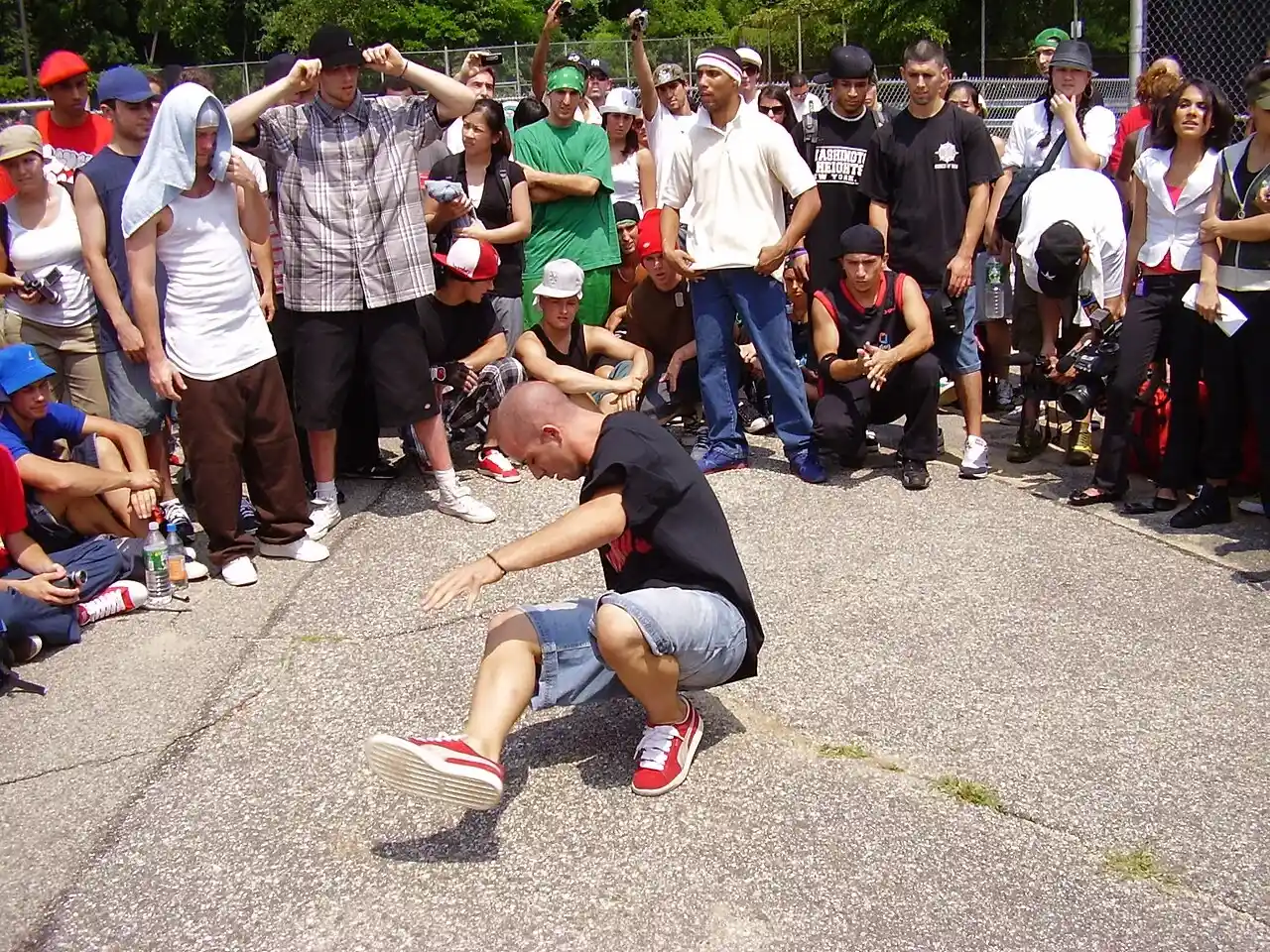
Breaking combines standing steps, footwork and floor movement. The photograph on this page shows this specific hip-hop tradition.
A group learns a repeatable sequence and shared timing. Ask how much improvisation it includes and how the movement's context is taught.
Breaking is one specific hip-hop dance tradition with toprock, footwork, freezes, power, and battle logic. A Hip-Hop class label may cover a much wider movement field.
Commercial Dance more often builds a repeatable result for camera or stage. Hip-hop practice may use choreography, but its groove, freestyle, and community history are wider.